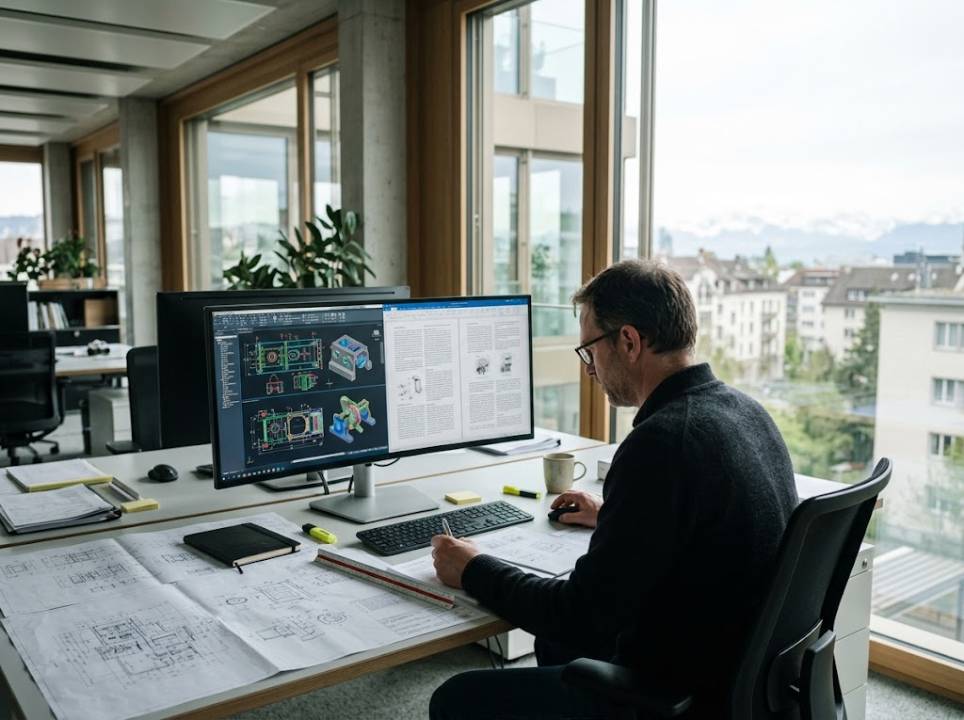
Switzerland builds precision machinery, medical devices, watches and industrial software for buyers all over the world. Every one of those products ships with paperwork: operating manuals, safety data sheets, maintenance guides, spare part catalogues. In a country with four national languages and an export economy, that paperwork rarely lives in just one language.
A single mistranslated torque value or warning label can cost far more than the translation budget ever did. Technical translation is not a finishing touch; it is part of the product.
Why technical documents are a category of their own
Marketing copy can bend. A brochure can paraphrase, adapt jokes and rewrite slogans so they land in Lyon or Lugano. Technical text has no such freedom. A step in an assembly procedure must say exactly what the source says, in the same order, with the same units and tolerances.
The vocabulary is also unforgiving. A German "Schraube" might be a screw, a bolt or a fastener depending on the drawing. A French "joint" could be a seal, a gasket or a joint in the mechanical sense. Only a translator who reads the drawing, not just the sentence, picks the right word every time.
The discipline has its own history and conventions, which you can explore in this overview of technical translation as a field. What matters for Swiss companies is simpler: the reader of the manual is often standing next to a running machine, and they need to understand the text the first time.
Where Swiss firms usually run into trouble
Most problems we see do not come from bad translators. They come from bad processes. Typical examples include:
- Manuals translated in pieces by different suppliers, so the same component has three different names.
- Source files sent as scanned PDFs, which forces retyping and invites errors in part numbers.
- No glossary, so every new project starts from zero.
- Updates to the German master text that never reach the French or Italian versions.
- Safety warnings translated without checking the wording against applicable standards.
Each of these is fixable, and none of them requires a bigger budget. They require a little discipline at the start of a project.
Building a terminology base before you translate
The most valuable document in any technical translation project is not the manual. It is the glossary. Before the first page is translated, the engineering team and the translator should agree on the approved term for every recurring component, function and warning.
This sounds bureaucratic, but it saves time almost immediately. A glossary of 150 to 300 terms usually covers most of a machine's documentation. Once approved, it travels with every future update, so the operator manual, the service manual and the training slides all speak the same language.
Consistency is what makes a manual trustworthy. If a technician sees "pressure relief valve" on page 4 and "overpressure valve" on page 19, they will reasonably wonder whether these are two different parts.
Choosing the right translation partner
Not every agency is set up for engineering content. When comparing providers of technical translation services, ask practical questions. Do their linguists have engineering or scientific backgrounds? Can they work directly in your file formats, such as InDesign, XML or FrameMaker? Do they use translation memory so you do not pay twice for repeated sentences?
It also helps to ask how they handle queries. A good technical translator asks questions. If a sentence in the source is ambiguous, they flag it rather than guess. That habit alone prevents many expensive corrections later.
The Swiss multilingual factor
Swiss companies face a challenge that firms in single-language markets do not. Products sold domestically often need documentation in German, French and Italian at minimum, and English is usually expected for export. That means four language versions that must stay in sync through every revision.
The smart approach is to treat one language as the master, usually German or English, and manage all others as controlled translations of it. Every change starts in the master file and flows outward. Translation memory makes this efficient, since only the modified sentences need new work.
Swiss regional usage matters too. Swiss German writing conventions differ from those in Germany, and Swiss French has its own preferences in certain technical and administrative terms. A translator familiar with the Swiss market will catch details that a generic provider might miss.
Quality checks that actually catch errors
A second linguist reviewing the translation is standard practice, but technical content benefits from one more step: a review by a subject matter expert in the target market. A French-speaking service engineer reading the translated maintenance guide will spot an awkward instruction faster than any linguist.
Automated checks also earn their place. Software can verify that every number, unit and part reference in the source appears unchanged in the translation. It can flag inconsistent terms against the glossary. These checks take minutes and remove a whole class of avoidable errors.
Planning translation into the product timeline
Translation is often treated as the last step before shipping, squeezed into the final week. That is where quality suffers. Instead, schedule translation alongside documentation writing. When chapters are finalised in stages, translators can start early and the full set of languages is ready at launch.
It is also worth writing the source text with translation in mind. Short sentences, active voice, consistent terminology and no unnecessary idioms make the source clearer for native readers and much easier to translate accurately.
A small investment with a long tail
Good technical documentation protects users, supports service teams and reduces liability. For Swiss exporters, it also protects a reputation for precision that took generations to build. Getting the translation right, consistently and in every language you sell in, is one of the simplest ways to keep that reputation intact.
Start with a glossary, pick a partner who understands engineering, and give translation a proper place in your schedule. The results show up in fewer support calls, smoother audits and customers who trust what they read.